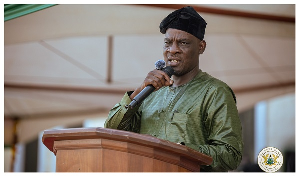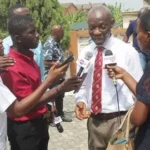


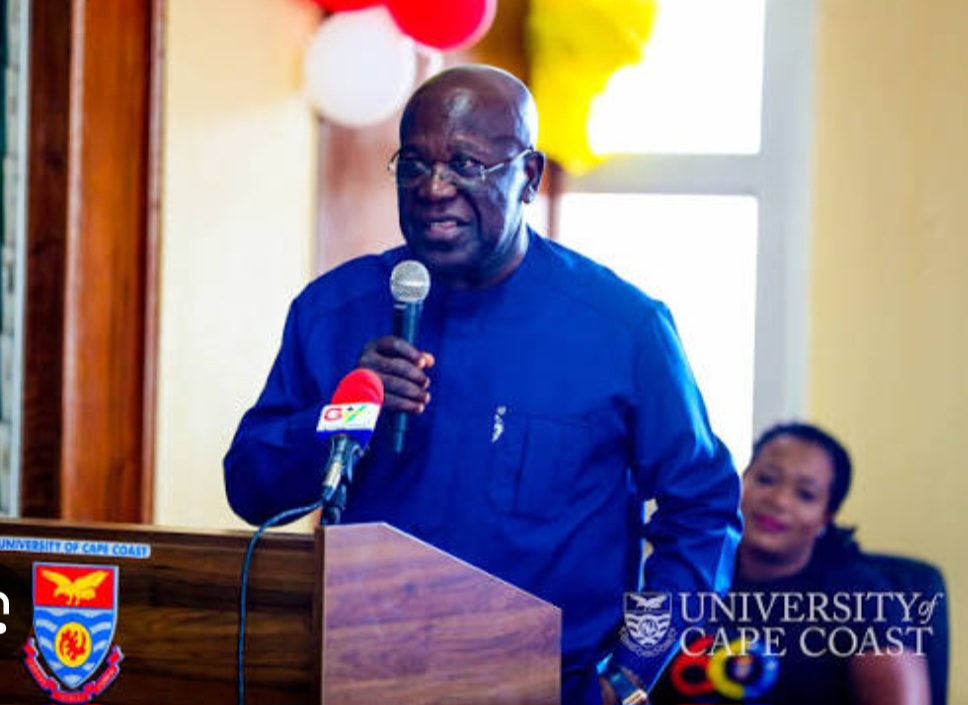
Chancellor of University of Cape Coast (UCC) Sir Sam Jonah has unveiled the new visionary Vice Chancellor of the University Prof. Dennis Worlanyo Aheto to chart the future of the next generation of the University.
In a speech under the theme “ WE HOLD THE PEN The University in the Age of Answers” which was described as most profound, powerful and inspiring, Sir Sam Jonah reveals how the search for the new Vice Chancellor was meticulously and cursory done to get the best fit and quality for the job.
“Today, we install a new Vice-Chancellor. And I want to be honest with you, Professor Aheto: I have not come here to hand you keys. I have come to hand you a storm. Fortunately for all of us, we are installing a man who has spent his entire career studying what happens where the storm meets the shore
Permit me first a word about how we arrived at this day. The search was rigorous, and it attracted candidates of remarkable calibre — several of whom sit in this hall, any one of whom would have served this University with honour. That is not a consolation; it is a compliment. Great universities produce more capable leaders than they have chairs to seat them in” Sir Jonah emphasized.
He advised the new Vice Chancellor to work closely with all his contenders for the prestigious job of a vice chancellor since they all have valuable expertise.
“And to you, Vice-Chancellor, the obligation runs both ways: draw these colleagues close, and let it be said that at Cape Coast, ambition knew how to bow to unity — and unity knew how to reward ambition”, he advised.
Chancellor of University of Cape Coast (UCC) Sir Sam Jonah
THE AGE OF ANSWERS
The respected Mining star and business mogul later stressed that UCC has been built on a single foundation: the scarcity of knowledge adding that for nine hundred years, since the first universities rose in Bologna and Timbuktu and Oxford, the Knowledge was rare, so the University built walls around it, admitted the fortunate few, and issued certificates to prove they had been inside.
He emphasized that, that world has ended quietly, “in our lifetime, and many of us have not yet noticed”.
“…Today, any student in Elmina with a smartphone carries in her pocket an intelligence that has read every book in every library on earth. It speaks every language. It solves equations, drafts contracts, writes code, passes medical licensing examinations. It does not sleep, does not strike, and does not ask for book and research allowance. That was science fiction when this University was founded in 1962. It is now an ordinary Saturday morning in Cape Coast”.
According to him, for the first time in human history, the cleverest entity in the room may not be a person and that the scarcity of answers is over as we now live in the Age of Answers — where answers are abundant, instant, and nearly free.
The Chancellor, later, in what appears to be a mind boggling question asked the new Vice Chancellor about what must a degree mean in a world where machines can pass our examinations? In reference to AI.
He said for generations, the university’s promise was simple: master a body of knowledge, prove it, and receive a certificate that opens doors maintaining that that promise built nations — including our own.
“But if a machine can now pass those same examinations in seconds, then a degree can no longer be a certificate of memory alone. It must become a certificate of capability — proof that its holder can solve problems, build, create, and exercise judgment. The degree is not dying; it is being redefined. And the universities that redefine it first will be the universities whose degrees are worth the most” Sir Jonah argued.
“…And what kind of graduates are we producing for this new world? I say this with love, but I must say it: too many of our graduates leave university having memorised much and built little. My friend ANIS HAFFAR says a student can score an A in music — scales, clefs, staccatos, all on paper — and be unable to play a simple flute. The world our graduates are entering will not ask them what they know. It will ask them what they can do.
Multiply that flute by a million, and you have the tragedy of African education: graduates who can describe agriculture but cannot grow a tomato; who can define entrepreneurship but have never sold anything. Knowledge of a thing is not the ability to do the thing. And a nation of people who know, but cannot do, will remain a poor nation — beautifully certificated, and poor”.
The Founder of JonahCapital later referenced Osagyefo Dr. Kwame Nkrumah whom he said saw this way back saying ‘We want thinkers,’ ‘thinkers of great thoughts. We want doers, doers of great deeds.”
Against that background the Chancellor reminded the new Vice Chancellor that Dr. Kwame Nkrumah founded the University in 1962 not as an ornament, but as a tool — to train the teachers who would build the nation.
“This University was born vocational. It was born with its sleeves rolled up. Somewhere along the way, we grew ashamed of our sleeves”, Sir Jonah stressed.
“Today, I am asking this University to roll them up again.
WHAT THE MACHINE CANNOT DO
The pessimists tell us artificial intelligence will take all the jobs. I do not believe it. But I do believe this: AI will take every job that consists of knowing things — and it will multiply the value of every job that consists of doing things in the physical world and caring for people in the human world.
Consider what cannot be downloaded. You cannot download a weld. You cannot email a haircut. No algorithm has ever fixed a burst pipe in Kotokuraba, rewired a transformer at Cape Coast, delivered a baby at Abura, or comforted a dying woman in her own language, holding her actual hand. AI can design a magnificent building in thirty seconds. It still cannot lay a single block. It can diagnose a tumour from a scan — but the steady hand that removes it, and the nurse who walks the patient back to life, are human, will remain human, and the world will need more of them, not fewer” he argued.
The Chancellor therefore proposed and envisioned that University of Cape Coast become the first university in Africa to build a full faculty of degree-awarding vocational education — Bachelor and Master degrees in Applied Skills, with the rigour of the academy and the soul of the workshop.
“Imagine it. A Bachelor of Applied Skills in Renewable Energy Systems — where no one graduates who has not personally installed and maintained a working solar installation.
Now — and here I speak directly to our new Vice-Chancellor and to the University Council — I know my countrymen. I know that if we simply build vocational institutes, Ghanaians will not come, because Ghanaians want degrees. Very well. Then let us stop fighting the addiction and start prescribing it wisely. I am proposing today that a degree in Coastal and Aquaculture Enterprise — building on the strength in fisheries that the man beside me built — where the final examination is a functioning fish farm, audited like a business. Degrees in construction, in agri-food, in care and community health, in the creative industries — and yes, in Human—AI Collaboration, training the technicians who will supervise the machines. Every programme co-designed with industry; every student spending sandwich semesters inside real enterprises — the German way; and every assessment authentic: not ‘describe a pump’, but ‘here is a broken pump; the village is waiting; fix it.’ The certificate and the competence, reunited at last.
Professor Aheto, you have spent a lifetime learning how coasts survive storms: they do not survive by hiding from the sea, but by building resilience into everything they are. The storm is yours now. So is the honour. Lead us” the Chancellor told Prof. Aheto
Source:www.senaradioonline.com