

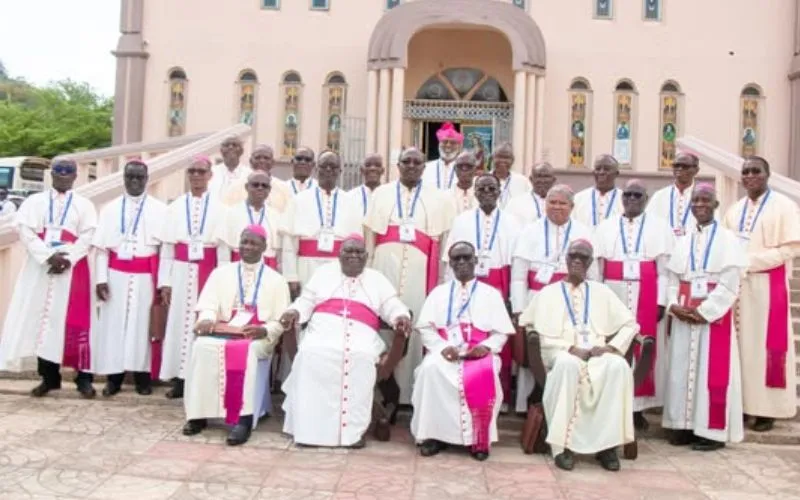
The Catholic Bishops Conference (CBC) is demanding an immediate review of what has become the Gender identity SHS Teacher Manaual Brouhaha.
This was contained in a release issued to the media on Friday (January 16, 2026).
Below is the Release
PRESS RELEASE
POSITION ON CURRICULUM CONTENT AND THE INTEGRITY OF GHANAIAN
EDUCATION
GHANA CATHOLIC BISHOPS’ CONFERENCE
We, the Catholic Bishops of Ghana, issue this statement out of deep pastoral concern for the moral, cultural, and spiritual formation of our children and young people. The family remains the foundational unit of society and the first school of virtue, faith, and conscience. Education must therefore serve the full and harmonious development of the human person: intellectual, moral, emotional, social, and spiritual. It must respect parental authority, honour Ghanaian cultural identity, and uphold the shared values that bind our nation together.
Recent public concern has arisen following the circulation of a Year 2 Senior High School Physical Education and Health Teacher’s Manual containing definitions and concepts inconsistent with Ghana’s cultural, biological, and moral understanding of the human person. This development caused understandable anxiety among parents, educators, and citizens who perceived a threat to traditional conceptions of family, personhood, and moral formation.
We acknowledge and welcome the clarification by the National Council for Curriculum and Assessment (NaCCA) that the officially approved national curriculum does not include LGBTQrelated lessons. We commend NaCCA for withdrawing the offending material and issuing a revised manual aligned with national norms and values. Nevertheless, we remain convinced that this incident reveals deeper weaknesses in oversight, consultation, and value alignment within curriculum development processes. Public trust in education depends on transparency, accountability, and fidelity to constitutional and moral principles.
We further acknowledge the public advocacy of Prof. Godfred A. Bokpin and Mr. Moses FohAmoaning, whose calls for a formal apology and an independent review reflect the conscience of many Ghanaians. Their interventions highlight the national expectation that education policy must remain rooted in Ghana’s cultural heritage, constitutional values, and moral integrity.
We wish to state clearly that our position paper on the matter is ready to be formally submitted to the Government of Ghana, the National Council for Curriculum and Assessment, the Ministry of Education, and the Ghana Education Service. Our intention is constructive engagement, institutional reform, and the strengthening of trust between families, schools, and the state.
Our Core Convictions
• Parents First: Parents are the primary educators of their children. Schools must partner with families, not replace them, in moral and value formation.
• Age-Appropriate Learning: Education must respect the developmental stages of children. Sensitive or contested topics should not be introduced prematurely or without parental involvement.
• Subsidiarity in Governance: Government must ensure quality education while respecting the rightful role of families and communities. Curriculum processes must be transparent and accountable.
• Cultural and Moral Coherence: Educational content must reflect Ghana’s cultural and religious values, upholding human dignity, family life, and moral responsibility.
• Democratic Accountability: Curriculum development must be inclusive, involving parents, educators, civil society, religious bodies, and traditional authorities to ensure legitimacy and public trust.
Our Broader Vision of Education
We view education as a sacred trust. As articulated by the Second Vatican Council in Gravissimum Educationis, education seeks the complete formation of the human person for both personal fulfilment and the good of society. This vision resonates deeply with Ghana’s educational philosophy, which aims to form responsible citizens grounded in moral uprightness and civic duty.
In our context, safeguarding the moral integrity of education is inseparable from safeguarding the cultural integrity of the nation. Ghana’s proverbs, customs, music, and communal traditions transmit enduring moral wisdom: respect, honesty, diligence, solidarity, and reverence for life. When educational materials introduce concepts detached from these moral roots, the result is not enlightenment but disorientation.
At the same time, we affirm that education must promote critical thinking, compassion, and respect for human dignity. Our children can be taught to reject prejudice and violence without adopting frameworks that contradict their faith or cultural worldview. A balanced education affirms the dignity of every person while preserving moral clarity.
The Way Forward
We call for a comprehensive review of curriculum development and editorial processes, with particular attention to transparency, accountability, and value alignment. We urge NaCCA and the Ministry of Education to conduct an audit to determine how unauthorised content entered teacher materials and to strengthen safeguards against future lapses.
We further call for the institutionalisation of regular stakeholder dialogue involving parent associations, teacher unions, religious and traditional leaders, and education experts. Capacitybuilding programmes for educators and curriculum developers should emphasise Ghanaian cultural and moral values alongside academic excellence.
We propose the establishment of ethical oversight committees, composed of educators, theologians, and cultural experts, to vet materials dealing with personal identity, relationships, or sexuality. We also urge stronger parental involvement through clear channels for reviewing sensitive materials and offering meaningful input. Finally, we call for open, timely, and consistent communication by education authorities to address concerns promptly and foster public trust.
Conclusion
We, the Catholic Bishops of Ghana, reaffirm our unwavering commitment to the moral and intellectual integrity of our nation’s education system. Education is not merely about producing skilled workers; it is about forming upright citizens, guided by conscience, rooted in truth, and committed to the common good. Ghana’s enduring strength lies in her reverence for God, her respect for family, and her devotion to community. These values must continue to shape what our children learn and how they learn it.
We call upon parents, teachers, policymakers, and religious leaders to stand with us in safeguarding the soul of Ghanaian education. Let our schools remain places where knowledge and virtue walk hand in hand, where truth is sought without fear, and where the values that unite us as Ghanaians are faithfully handed on to the next generation.
Most Rev. Matthew Kwasi Gyamfi Bishop of Sunyani and President,
Ghana Catholic Bishops’ Conference
ISSUED ON FRIDAY, JANUARY 16, 2026
source:www.senaradioonline.com