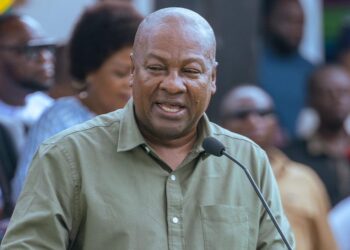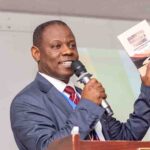


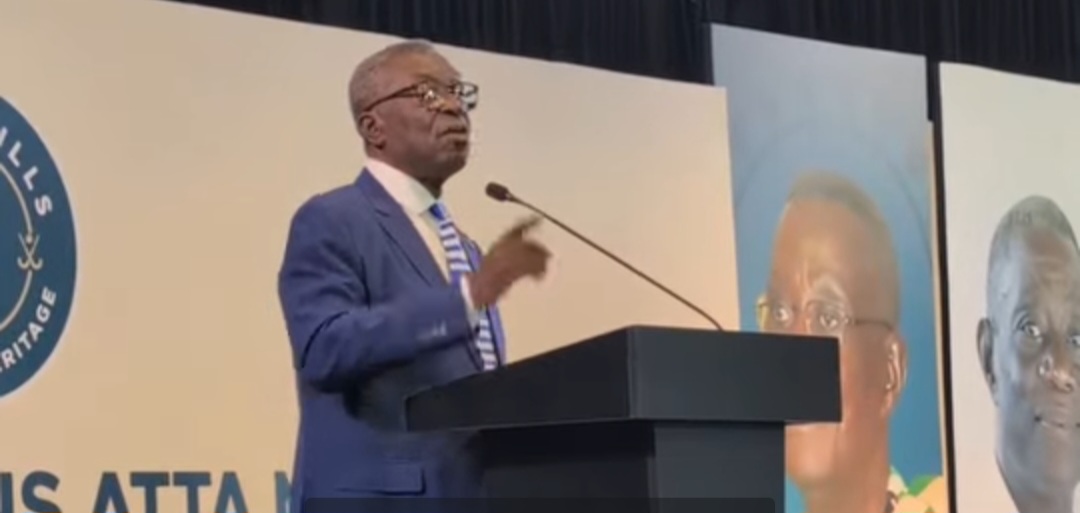
Former Minister for Environment Science and Technology Prof. Kwabena Frimpong Boateng has stated eulogized former President John Evans Atta Mills saying to honor him meaningfully is to be honest about the condition of the country he loved and served.
He said President Mills never represented this modern day politician where corruption and fleeing the public purse is their priority.
He said President Mills’s anti-corruption and humility is a legacy that will live with us for a long time.
Prof. Boateng made the statement when he delivered a Lecture in commemoration of 14th Anniversary of the passing of J.E.A Mills in Accra on Wednesday.
He touted President Mills’ Better Ghana Agenda describing it as bold policy.
“Professor Mills coined the term “Better Ghana Agenda” in 2007 to address the shortcomings in Ghana’s socio-economic development — the economy, employment, the environment, health, education, agriculture, utilities, transportation and public discipline”, he emphasized.
He explained that the thrust of the policy was not to declare Ghana “good” overnight, but to progressively improve deficiencies so that one day it could be called good.
“It was a process — a direction of travel.
In the little over three years that the policy was in implementation, appreciable gains were recorded across virtually all sectors:
• Strong economic growth and a significant reduction in the budget deficit
• A fall in inflation to single digits
• Elimination of schools under trees and expansion of universal healthcare coverage
• Solid environmental sustainability portfolios”, Prof Boateng stated.
Below is the full statement
ATTA MILLS, FOURTEEN YEARS ON: A BETTER GHANA, STILL UNBUILT
14th Anniversary Commemorative Lecture
Accra, July 22 2026
Delivered by Prof. Kwabena Frimpong-Boateng
Ladies and Gentlemen, I believe everyone in this auditorium — and all those watching or listening within Ghana and across the world — will agree that the legacy of Professor John Evans Atta Mills is defined by peace, humility, integrity, transparency, accountability, academic excellence, and servant leadership. His tenure as the third President of the Fourth Republic was anchored in the rule of law and ethical governance.
It is good to remember what President Mills accomplished in the three and a half years that God gave him to serve Ghana. Yet remembering what he stood for compels us to ask a more searching question: what would have been the condition of Ghana today if President Mills had had the strength to complete his first term and, most probably, had also served a second? I believe we must have the courage not only to ponder that question, but to hazard some answers.
The management of his legacy itself exposes some of the contradictions in our society. President Mills served from January 7, 2009, until his death on July 24, 2012. He was buried at Asomdwe Park on August 10, 2012.
After years of neglect, a number of Professor Mills’s friends, admirers and loyalists appealed to President Akufo-Addo to restore the park. It was done and the completed facility was commissioned on July 24, 2022, the 8th anniversary of his passing.
It also took another act of generosity — from Dr. Matthew Opoku Prempeh (NAPO) — to fund the construction of the Atta Mills Memorial House and Library at Ekumfi Otuam, the ancestral home of Professor Mills.
That facility was inaugurated in November 2024. Meanwhile, the John Evans Atta Mills Presidential Library and Research Facility, constructed and inaugurated in 2016, is reported to be in a state of disrepair. I am informed that renovation work have starte and I commend the government for it.
The floods that struck Greater Accra in the last week of June and the first week of July this year are a distressing illustration of the very same institutional neglect. As the waters rose, I listened to politicians and opinion leaders urge residents not to dump waste into gutters and drains — advice that, however well-intentioned, evades a deeper truth: Ghana has no serious system for collecting waste at the point of generation and moving it to disposal, recycling or power-generation sites. Ghana’s own land-use planning framework classifies land below the 1-in-20-year flood level as flood-prone and reserves it as protected open space, yet across the Greater Accra Metropolitan Area all seven of the planned flood-retention ponds ( Papao, Madina, Oshiyie, Adjirigano, Ashale- Botwe (2No), University Farms, Ashaiman) — and the buffers meant to protect watercourses such as the Lafa — have been overrun by informal development, sanctioned or tolerated by the very institutions charged with enforcing the law. On the western edge of the city, a cement factory now stands inside a Ramsar-protected wetland, sod-cut in 2020 before an Environmental Impact Assessment had even been completed, and pushed to completion each time regulators tried to stop it. A nation that cannot summon the discipline to manage its own waste and protect its own wetlands cannot, by any stretch of the imagination, undertake the disciplined, sustained project of national development that President Mills envisioned.
Personal Encounters with the Asomdwehene
When I was approached to deliver this lecture, I asked myself a simple question: why me?
I never belonged to President Mills’s party. And twice, he dismissed me.
When I was approached to deliver this lecture, I asked myself a simple question: why me?
I never belonged to President Mills’s party. And twice, he dismissed me.
The first dismissal came over the radio in January 2009 — one of the earliest announcements of his presidency. I learned, along with the rest of the country, that I had been removed as Chairman of the Public Utility Regulatory Commission, a chairmanship that had, until that broadcast, been widely regarded as exemplary.
The second one was delivered in person. I had received a dismissal letter from the Minister for Health on August 25, 2011. President Mills came himself to the National Cardiothoracic Centre on Tuesday August 30, 2011, accompanied by his own Achimota schoolmate, a professor of medicine who then chaired the Korle Bu Teaching Hospital Board, to confirm with his own eyes that I had packed my belongings and gone.
I stand here tonight anyway. Not despite those two dismissals, but, in a sense, because of them — they are my credentials. A man who was removed twice by President Mills has no motive to flatter his memory. If I speak well of him, it is not because I owe him anything. It is because I knew him. I knew him from three encounters, eleven years before the presidency ever touched him — and in those three hours across three meetings, I came to know exactly who he was: a good man.
I know something else too, and I say it not to excuse but to explain. The illness that would eventually take his life appeared to have affected his effectiveness. As the presidency wore him down and his strength declined by degrees, there were some people in his administration who saw an opening — who used his fragility to pursue their selfish agenda or settle scores that were never his to settle, in a name that was never truly theirs to invoke.
Let me be precise about what I am, and am not, saying. Professor Mills was ethical. He was compassionate. By every measure I was able to take of the man, across three private hours, he was good. That is the man I will now ask you to meet — not through the office he held, but through the three mornings and afternoons in which he showed me who he was before the world knew him as the Asomdwehene.
Those who knew Professor Mills, even briefly, encountered the same man twice: the private figure and the public one were not different people wearing different masks — they were the same person, at different volumes. His warmth toward people and severity toward wrongdoing were, in him, the same virtue pointed in two directions.
Prof. Mills carried himself exactly as Exodus 18:21 instructs: a man who feared God and hated dishonest gain.
But goodness in a president is not self-executing. It does not, by itself, become honest and ethical governance — because the man is not the system, and in Ghana, the character of those who surround a good man can undo everything his own character was built to achieve.
I knew Professor Mills at a level not many can imagine. The three meetings already alluded to, shaped my understanding of the man.
The First Meeting — 1998
In 1998, I was visited by Professor Hans-Georg Borst, the extraordinary individual who gave me the opportunity to pursue my post-graduate training in Cardiothoracic and Vascular Surgery in Germany. I informed Dr. Eunice Brookman-Amissah, the Minister for Health, who graciously led Professor Borst and a delegation from the National Cardiothoracic Centre to pay a courtesy call on Vice President Atta Mills at the Osu Castle. It was a warm occasion. Professor Mills commended Professor Borst for his role in establishing the Cardiothoracic Centre in Ghana, and Professor Borst in turn expressed hope that the Ghanaian authorities would provide the necessary support for Cardiothoracic Surgery to flourish.
Prof.J.E.A. Mills Prof. Hans-Georg Borst
It is worth noting that Dr. Kwaku Atuahene, a classmate of Professor Mills at Achimota School, also trained under Professor Borst in Germany. Dr. Atuahene had often spoken well of Professor Mills during their Achimota days to me — a testimony that was borne out in every subsequent encounter.
From Left: Dr. A.G.B. Amoah (partially hidden), Sister Juliana Agyei, Dr. Kwabena Frimpong-Boateng, Dr. Eunice Brookman-Amissah, Prof. Hans-Georg Borst, Mrs. Borst, Prof. J.E.A. Mills, Dr. Mrs Mary Grant, Dr. Cornelius Kallen, Dr. Ernest Aniteye
The Second Meeting — 1999
The second meeting arose from a difficult situation. A Minister of State brought children requiring heart surgery to me on four occasions, each time invoking the name of the First Lady Nana Konadu Agyeman Rawlings as the referral authority. I managed the first three cases without question, the Cardiothoracic Centre bearing the costs. When the Minister appeared a fourth time, I asked whether the First Lady might contact me directly so that I could discuss any challenges with her. My simple request was apparently misrepresented, and word reached the President’s office that I had refused to take instructions. Ambassador J.L.M. Amissah, the President’s Secretary, told me the President was incensed: “Who is this Frimpong-Boateng? Who does he think he is? He is growing wings.”
I resolved to go to the Castle and explain myself. Many, including Ambassador Amissah, counselled against it — but I went nonetheless. Providentially, the President had travelled. I was directed instead to Vice President Atta Mills.
He received me warmly. After I explained what had brought me to the Castle, Professor Mills looked at me for a moment and said: “Doctor, you are not in Ghana because of one person. You came down from Germany to serve Ghanaians, and that should be your focus. Forget everything you were told and go back to Korle Bu to do what you know best.”
I said to myself: “I should have known that.” That was the Asomdwehene — the Man of Peace — before the world came to know that side of him. He added something revealing: “Doctor, let me tell you something: if you knew what I go through on a daily basis in this house, you would not have driven from Korle Bu to complain to anybody.” I heeded his advice and returned to my work. (I should add that in later years President Rawlings and Mrs. Konadu Agyeman-Rawlings became friends of mine — she like a sister, he like a big brother — and Dr. Mary Grant liked to say she had two adopted sons: Jerry Rawlings and Frimpong-Boateng.)
The Third Meeting — June 2001
The third and most consequential meeting took place in my office at Korle Bu in June 2001. The NDC had lost the December 2000 general election, and Professor Mills was scheduled to travel to Canada in September 2001 to take up a one-year appointment as Visiting Scholar at the University of British Columbia and Senior Associate at the Liu Centre for the Study of Global Issues.
As part of the visa application process, Professor Mills required a medical examination. All test results were normal except the Electrocardiogram (ECG), which the examining physician had flagged for a second opinion. Professor Mills arrived with his ECG tracings. I called in one of our cardiologists, and after careful review we were satisfied that the ECG was normal. When the cardiologist left, Professor Mills and I sat together for a little over an hour and spoke frankly about governance, national development, patriotism and the fight against corruption.
In that one hour I came to understand the mindset of Professor Mills very clearly — what motivated his principled, Godly stance on national issues. We agreed that Ghana would not achieve any appreciable development without sustained attention to fighting corruption and building indigenous capacity in science, technology and industry. We agreed that the fundamental structure of the economy had to change: from one dependent on the export of raw materials, to one where Ghanaian ingenuity is harnessed through Science, Technology and Innovation to drive sustainable development.
This address draws on the issues we discussed that afternoon. It also reaches beyond them to reflect on what Professor Mills would have confronted had he been with us today.
The Themes of Our National Challenge
To honour Professor Mills meaningfully is to be honest about the condition of the country he loved and served. The themes I shall address are these:
- Better Ghana Agenda
- Governance and the fight against corruption.
- Ghana and the problem of self-deception
- Ghana — a country of missed opportunities
- The poverty gap is a technology gap
- The daily burden of Ghanaians
The Better Ghana Agenda: What Was Achieved
Professor Mills coined the term “Better Ghana Agenda” in 2007 to address the shortcomings in Ghana’s socio-economic development — the economy, employment, the environment, health, education, agriculture, utilities, transportation and public discipline. The thrust of the policy was not to declare Ghana “good” overnight, but to progressively improve deficiencies so that one day it could be called good. It was a process — a direction of travel.
In the little over three years that the policy was in implementation, appreciable gains were recorded across virtually all sectors:
- Strong economic growth and a significant reduction in the budget deficit
- A fall in inflation to single digits
- Elimination of schools under trees and expansion of universal healthcare coverage
- Solid environmental sustainability portfolios
- In 2010, following a GDP re-basing exercise, Ghana officially achieved Lower Middle-Income Country (LMIC) status
- Ghana’s cocoa sector reached a historic milestone: one million metric tonnes of production for the first time
- On December 15, 2010, President Mills commissioned the First Oil from the Jubilee Field — an event that marked Ghana’s formal entry into the ranks of oil-producing nations.
It must be acknowledged that the oil discovery was made under the Kufuor administration; it was President Mills’s government that supervised the crucial development phases and brought the project to commercial production.
Two new specialized public universities were established during his tenure: the University of Health and Allied Sciences in the Volta Region, and the University of Energy and Natural Resources in the Brong-Ahafo Region. His administration also launched a programme to re-equip science resource centers in all districts, to strengthen the teaching and learning of science across the country.
These were not cosmetic achievements. They were the early yield of purposeful, integrity-led governance.
Governance and the Fight Against Corruption
One of the subjects Professor Mills and I discussed most earnestly during our 2001 meeting was corruption. We had both studied the transformation of Singapore under its first Prime Minister, Mr. Lee Kuan Yew. When Lee Kuan Yew’s government took office in 1959, he declared that his administration was “sickened by the greed, corruption, and decadence of many Asian leaders” and that he had “a deep sense of mission to establish a clean and effective government.” With determination and a credible programme built on scientific and technological development, Lee Kuan Yew and his team delivered on that promise. Singapore — a village of 120 fishermen in 1819, without natural resources or a hinterland — propelled itself from third-world squalor to first-world prosperity in just 35 years.
Professor Mills, despite operating within an entrenched Ghanaian system, attempted to do things differently.
- He significantly reduced the number of Ministers from 87 under the preceding Kufuor’s government to 73 — a reduction of 16%, with projected annual savings of USD 4 million
- Hundreds of Special Assistants, Presidential Staffers and Spokespersons were eliminated to improve fiscal discipline
- He commissioned a review of the 1992 Constitution, inaugurating the Constitution Review Commission on January 11, 2010, under the chairmanship of Prof. Albert K. Fiadjoe
- The Commission submitted its report on December 20, 2011, and Government issued a White Paper and established a five-member Implementation Committee, though the actual amendment process was deferred pending the 2012 elections
President Mills demonstrated that accountability was not merely rhetorical. Barely six months after he was sworn in, one minister resigned following findings of financial impropriety. Two further ministers tendered their resignations in October 2009 after allegations of accepting bribes from a United Kingdom company surfaced. Throughout his tenure, under-performing and ethically compromised ministers were removed — consistently, visibly and without sentiment.
These were not the actions of a man performing accountability. They were the actions of a man who believed in it.
Contrast that record with a more recent episode that shows how far we have drifted. During the banking-sector clean-up, a number of bank owners were found to have used depositors’ funds to enrich themselves, and were arraigned before the courts to answer for it. When a new government, formed by the opposition, took office, the Attorney-General simply announced that the state was no longer interested in pursuing the cases. A legitimate legal process already under way was terminated by fiat. The men who stood accused of stealing from ordinary depositors were not merely released — some were rewarded with lucrative appointments, and one was even given a gold mine. If Professor Mills’s insistence that ministers accused of wrongdoing be removed without sentiment reflected an ethic of accountability, this episode reflects its opposite: an ethic of impunity, in which political victory becomes a shield against justice rather than an occasion for it.
Ghana and the Problem of Self-Deception
A Constitution Without Cultural Roots
Our Presidential system of government is modelled on the American system, just as the Second Republic was modelled on the Westminster system. In adopting the American presidential model, however, we did not adequately research its cultural and spiritual foundations.
The American constitution is built on a distinctly biblical understanding of human nature — specifically, that man is fundamentally fallible and prone to sin. It is precisely this understanding that produced the elaborate system of checks and balances: independent executive, legislative and judicial branches, each limiting the power of the others. The separation of powers was drawn, whether consciously or not, from Isaiah 33:22: “For the Lord is our judge, the Lord is our lawgiver, the Lord is our King; it is he who will save us.” The Founding Fathers of America trusted no single person with all three powers — not even themselves. That restraint is the foundation of their democratic durability. Ghana prepared a 4th Republican Constitution that makes the President so powerful that he/she is able to exert influence on the judiciary and the Parliament. Worse still, to protect the excesses and the corruption of the President, entrenched provisions are crafted to shield the President from the reach of the law after he/she exists the presidency. This is not how Democracy looks like.
The governance systems of all traditional areas in Ghana endure precisely because they are rooted in the traditions, beliefs and spirituality of the people. In the Asante Kingdom, for instance, people think carefully before invoking the Great Oath of the Asantehene — because there are real consequences when oaths are flouted.
Those who doubt the importance of spiritual and cultural foundations to constitutional longevity need only compare the American Revolution of 1776 with the French Revolution of 1789. The American Revolution began with an appeal to the sovereignty of God; the French Revolution was founded on the sovereignty of man — on the liberal humanistic philosophy of Voltaire, Rousseau and Montesquieu. The French Revolution was a catastrophe: chaos, anarchy and tyranny left 40,000 dead, and the resulting constitution lasted only two years. France has had seven constitutions in the same period that America has had one. Ghana, independent for ‘only’ seventy years, has had four constitutions — and the fourth is already under review.
Who Should Lead Us?
Since we have chosen a democracy whose roots lie in biblical precept, we should also attend to what those precepts say about leadership. In Exodus 18:21, Moses receives this instruction: “Select capable men — men who fear God, trustworthy men who hate dishonest gain — and appoint them as officials.” Deuteronomy 1:13 echoes it: “Choose wise, understanding men, and I will set them over you.”
Professor John Evans Atta Mills was such a man. He understood the eternal principles that must undergird governance. He understood bribery not merely as a legal infraction but as a moral offence against his people. That understanding shaped every decision he made in public life.
A leader who professes faith but is not genuinely committed to God is merely a pretender — one who does not appreciate the principles that must be followed if a nation is truly to be served.
Ghana: A Country of Missed Opportunities
The Abandoned Seven-Year Development Plan
Ghana’s first and most consequential missed opportunity came at the very dawn of its economic life. In 1963, Dr. Kwame Nkrumah presented to Parliament the Seven-Year Development Plan for National Reconstruction and Development (1963/64–1969/70) — a programme designed to carry Ghana toward import substitution and industrial job creation, and in time toward the export of manufactured goods and services. It was conceived as something more ambitious than a public investment programme: a deliberate effort to root the nation’s growth in its own productive and scientific capacity, drawing on the work of the Council for Scientific and Industrial Research (CSIR), the Ghana Atomic Energy Commission (GAEC) and the universities — Kwame Nkrumah University of Science and Technology chief among them.
The Plan survived barely three years of implementation. When Nkrumah was overthrown in the coup d’état of February 24, 1966, the Seven-Year Plan was terminated with him, and Ghana’s path toward a self-reliant, technologically driven economy was abandoned along with it. Had the Plan been allowed to run its course — and had successive governments built upon it rather than discarded it — Ghana might well have kept pace with countries such as South Korea and Malaysia, both of which entered the 1960s at levels of development comparable to, or behind, Ghana’s own. Instead, as later sections of this lecture will show, those countries pulled decisively ahead while Ghana’s research institutions were left to wither. The abandonment of the Seven-Year Plan was not merely the loss of one administration’s policy; it was the forfeiture of Ghana’s first genuine opportunity to convert political independence into industrial self-sufficiency.
The Kofi Annan Moment
For nine years, a Ghanaian led the United Nations. We were proud. We had every right to be. But pride is not policy, and admiration is not strategy. Ghana never leveraged that extraordinary relationship to seek transformative assistance from the UN system, particularly the United Nations Industrial Development Organization (UNIDO) — to place the country on a path of sustainable socio-economic development.
Ghana’s first real industrial partnership with UNIDO was not signed until 2019 — thirteen years after Kofi Annan left office, and financed mostly by Europe, not by us. Compare that to India. A founding member of UNIDO in 1966, India spent over fifty years building on that relationship, decade after decade, government after government, until it became one of UNIDO’s top ten donors, paying into the Industrial Development Fund and hosting UNIDO’s regional office for South Asia. India went from asking for help to giving it. That is what fifty years of discipline looks like. Ghana has no such story.
And even where help did arrive, we were not always ready to receive it with integrity. The Global Fund, another Annan legacy, found a Ghanaian partner organization had abused the very people it was meant to protect. It was never opportunity we lacked. It was discipline. On the Kofi Annan moment, as on so much else, we let the moment pass.
The Mines University We Have — and the Plans We Lack
There are few countries in the world with universities or schools dedicated to the study of mines. Among them are the Colorado School of Mines (USA), the Western Australia School of Mines at Curtin University, McGill University (Canada), Central South University (China), the University of the Witwatersrand (South Africa), TU Bergakademie Freiberg (Germany), and the Camborne School of Mines (UK). Ghana has the George Grant University of Mines and Technology in Tarkwa — formerly the Tarkwa School of Mines.
The countries on that list have built sustainable mining industries using indigenous technology and locally developed human capital. Ghana has not. Instead of advancing sustainable mining with the graduates our own university produces, we are content to promote illegal small-scale mining — galamsey — that destroys our environment, our rivers and our biodiversity. What is the point of having a School of Mines if we have no national plan for its graduates?
The Poverty Gap Is a Technology Gap
The most important agreement Professor Mills and I reached in that June 2001 conversation was this: the real and decisive difference between the developed countries of America, Europe and Asia and the underdeveloped countries of Africa lies not in resources, not in geography, but in technological capability — the extent to which a country can access, utilize and create science and technology for the solution of its socio-economic problems.
Energy, agriculture, medicine, clean water, transportation, sanitation, the management of natural resources — all ultimately rest on science and technology. To be part of the modern world, a country must allow science, technology and innovation to drive its development. Most African countries, including Ghana, have declined that invitation.
The numbers are stark. Africa is the second-largest and second-most-populous continent, covering 20.4% of the Earth’s land surface and home to about 16% of the world’s population. Yet Africa’s contribution to world trade is less than 1%. The bottom 25 countries on the United Nations Human Development Index are all in Africa. We spend USD 4 billion recruiting and paying 100,000 foreign experts while 250,000 equally qualified Africans leave the continent to work elsewhere, often for lower salaries. In Ghana, approximately 80% of inputs into agriculture, education and health come from foreign sources. Ghana is ranked 47th in the world by population — and 148th out of 181 countries on the Human Development Index.
The Korean and Chinese Lessons
South Korea transformed itself from a stagnant agrarian society into one of the world’s most dynamic industrial economies in under 40 years. In 1961, Korea’s GNP was a mere USD 2.3 billion — USD 87 per capita — drawn almost entirely from primary sectors. Its three leading exports as late as 1970 were textiles, plywood and wigs. Korea is today the 13th largest economy in the world, a global leader in semiconductors, Liquid-crystal Display (LCD) technology, telecommunications equipment, automobiles and shipbuilding. Samsung, which started roughly 87 years ago selling dried fish, now accounts for approximately 23% of South Korea’s GDP and generates annual revenues of USD 240 billion — more than the GDP of 150 countries, including Ghana.
China’s transformation is equally instructive. On March 3, 1986, four of China’s leading scientists — Wang Daheng, Wang Ganchang, Yang Jiachi and Chen Fangyun — wrote a private letter to Deng Xiaoping warning that decades of military focus had crippled China’s civilian scientific establishment. They urged China to join the world’s “new technological revolution” or be left behind. Deng scribbled on the letter: “Action must be taken on this now.” The result was the 863 Programme — a long-term, heavily funded national commitment to biotechnology, space technology, information technology, laser technology, automation, energy and advanced materials, later expanded to include telecommunications and marine technology.
China doubled its wind-power capacity in 2006, then doubled it again the next year, and the year after. It had virtually no solar industry in 2003; five years later it was manufacturing more solar cells than any other country. The lesson is not that China is uniquely gifted. The lesson is that a government made a deliberate, long-term decision and held to it across successive administrations.
No country has ever developed without the capacity to produce the machines, spare parts, equipment and technical goods needed to power its own economy. Ghana must build that capacity. The fight for genuine economic independence is greater than the fight for political independence.
The Danger of Short-Term Initiatives
For far too long, Ghanaian governments have measured their success by the infrastructure they construct: roads, schools, hospitals, dams. These are not unimportant. But they are not, by themselves, development. The true measure of successful leadership is the extent to which the people can be mobilised to lead independent lives — to feed, shelter, clothe and heal themselves; to produce the tools, implements and spare parts they need for daily living, so that if, for any reason, ships and aircraft could not reach our shores, we could stand and survive.
This requires long-term planning and execution. What we have instead is a succession of politically named programs that disappear when the president who launched them leaves office. Planting for Food and Jobs reached over 1.2 million farmers between 2017 and 2022 — yet by 2025, virtually nothing remained of it. The One District, One Factory initiative, Agenda 111, the 24-Hour Economy, and Nkokɔ nketenkete are cut from the same cloth: well-intentioned, politically announced, and structurally incapable of outlasting a change of government.
Any genuine development programme must place research institutions — the CSIR, GAEC, the universities, the Ghanaian diaspora — at the centre, not the periphery. Science and technology infrastructure must be built and sustained across administrations, not tied to the fortunes of individual governments.
The Abdication of Responsibility
There is a pattern more troubling than short-termism alone, and it must be named plainly: successive governments of the Fourth Republic are not merely failing to invest in Ghana’s institutions — they are actively abandoning their obligations to them. What began as under-funding has become abdication.
Our universities are chronically starved of public funds. The predictable result is that institutions turn to student fees as their primary — and in many cases their only — source of income. The consequence falls hardest on those least able to bear it: students from poor backgrounds who cannot afford the fees charged are effectively denied access to tertiary education. We speak endlessly about human capital and inclusive development, yet we have constructed a system that bars the door to the very young people whose talents Ghana most needs. A nation that cannot educate its own children has no credible claim to development.
Research institutions face the same indignity. The Council for Scientific and Industrial Research (CSIR) and the Ghana Atomic Energy Commission (GAEC) — institutions that should be the engines of Ghana’s technological transformation — have been instructed by successive governments to commercialize their research activities simply to keep their doors open. This is a profound misunderstanding of how science works and how nations develop. No country that has achieved technological advancement has done so by demanding that its publicly mandated research institutions pay for themselves through the market. South Korea, China and Singapore do not operate this way. They fund their research institutions generously and hold them to account for outcomes — not for revenue. Ghana asks its scientists to be entrepreneurs first and researchers second, and then wonders why there is no indigenous technological breakthrough to show for it.
Perhaps most alarming is the fate of the Ghana Environmental Protection Agency. The EPA has been left to fend for itself financially — instructed to find the money to pay its own employees and fund its regulatory functions. The result is entirely predictable: an agency charged with protecting Ghana’s environment, biodiversity and public health has been reduced to issuing permits as a revenue-generating exercise, without the capacity to provide meaningful oversight, conduct proper environmental impact assessments or enforce compliance. It is therefore no surprise that environmental pollution is visible everywhere — in our rivers, our air, our soil. Galamsey destroys our water bodies not merely because of lawlessness, but because the institution mandated to prevent that destruction has been defunded into irrelevance.
This abdication is not accidental. It is the cumulative result of governments that treat public institutions as liabilities rather than assets — that see the state’s developmental role as an inconvenience rather than a duty. Professor Mills understood the duty. He reduced the size of government not to weaken the state, but to make it leaner and more capable of fulfilling its core obligations.
A government that cannot fund its universities, its scientists and its environmental regulators has not found a clever way to save money — it has found a certain way to destroy its country’s future.
The Daily Burden of Ghanaians
Let us speak plainly. For millions of Ghanaians, each day begins not with promise but with calculation — a silent, grinding arithmetic of what can be afforded, what must be sacrificed, and what will simply go without. The indicators of macroeconomic recovery are real, and they matter. But they do not travel to work by trotro in the heat of Accra. They do not pay two years’ rent in advance. They do not skip meals so that children can eat. The lived reality of ordinary Ghanaians and the story told by headline statistics have, for too long, diverged — and that divergence is a moral failure of governance.
The burden is not abstract. It is measurable, documented, and mounting. Housing, food, transport, utilities: each of these is a pressure point. Together, they constitute a system of quiet suffering that no responsible government can continue to treat as inevitable background noise.
The Numbers Behind the Burden
| Issue | Key Figure | Source |
| Housing deficit | 1.8–2 million units | GREDA / World Bank |
| Annual housing gap | Only 33% of need met annually | World Bank |
| Food insecurity | 13.3 million Ghanaians (2024) | Ghana Statistical Service |
| Transport cost burden | Up to 22% of monthly salary | News Ghana / IGC |
| Average Accra commute | 110+ minutes one way | National Transport Survey |
| Electricity tariff rise | +142% over five years (2020–2025) | Finex Insights |
| Income inequality (Gini) | 43.5 — above global median of 35.9 | World Bank / TheGlobalEconomy |
Transportation: The Daily Tax No One Voted For
Before we speak of any other burden, we must speak of transport — because transport is the first thing millions of Ghanaians confront every morning and the last thing they endure every night. It is where the failures of governance are most personal, most physically felt, and most inescapable.
The data is damning. According to the National Transport Survey, the average one-way commute in the Greater Accra Metropolitan Area is over 110 minutes — for an average distance of just 3.28 kilometres. Working days in Greater Accra average over twelve hours when commuting is included. Research published in the Journal of International Development confirms that commuting in the Greater Accra Region adds, on average, two full hours to the working day. And these are not comfortable journeys — they are spent in overcrowded trotros, in heat, in gridlock, in discomfort that erodes both body and spirit before the working day has even begun.
The financial toll is equally severe. Daily commuting expenses now consume up to 22 percent of monthly salaries for middle-income workers in Accra — amounting to approximately GH₵5,300 per year for a worker earning between GH₵2,000 and GH₵3,000 monthly. More than 70 percent of Accra’s daily commuters depend entirely on informal trotro services, which alone account for an estimated 3.5 million passenger trips every weekday. Half of all commuting workers in Greater Accra cite poor roads as their primary barrier. This is not a transport problem. It is a governance problem — one with a daily, measurable cost borne entirely by ordinary citizens.
Every Ghanaian who pays taxes is paying the people in government to improve their lives. Not in speeches. In results that visibly and measurably lessen the daily burden of the ordinary citizen.
Achieving meaningful change demands a comprehensive, funded, and politically protected programme — not a policy announcement that lasts one administration. The targets must be specific and non-negotiable: every worker and commuter in Greater Accra should be able to reach home within one hour; within 45 minutes in Greater Kumasi; within 30 minutes in Tamale, Sekondi-Takoradi, Wa, Navrongo, Ho, and Cape Coast. Those are not aspirations. They are the minimum standard owed to every Ghanaian who pays into this state.
Getting there requires:
- Full functionality of every traffic light in every city, maintained and monitored as a non-negotiable urban standard;
- Comprehensive traffic regulation enforcement — not occasional crackdowns, but consistent, embedded discipline;
- Dedicated bicycle lanes in all major urban centres, making cycling a viable, safe, and dignified mode of transport;
- Reliable, affordable intra-city bus services with published timetables and enforceable standards;
- A phased tram and light rail programme for Greater Accra and Kumasi and later in other cities, funded and designed to survive changes of government; and
- A national railway network built not for ribbon-cutting ceremonies but for daily freight and passenger movement.
These are achievable. Countries far poorer than Ghana have built them. The question is not whether Ghana can afford to do this. The question is whether Ghana can afford to continue as it is.
Housing: A Crisis of Two Million Families
Ghana faces a housing deficit of between 1.8 and 2 million units — and the gap widens by at least 100,000 units every year, because we are building far less than demand requires. The World Bank estimates that Ghana meets only 33 percent of its annual housing need. Over 60 percent of Ghanaians live in informal settlements without reliable access to clean water and sanitation. These are not statistics from a country in crisis. They are statistics from a country that has accepted crisis as its normal condition.
The consequences fall heaviest on those least able to bear them. The average Ghanaian household spends over 30 percent of monthly income on housing. In Accra, landlords routinely demand two or more years’ rent in advance — an upfront payment that can equal a full year’s salary for a nurse, a teacher, or a security officer. Formal mortgage financing is effectively unavailable to most citizens: mortgage penetration remains below five percent. High interest rates, short repayment terms, and relatively low incomes have placed homeownership beyond the reach of an entire generation of working Ghanaians. The result is overcrowding, family instability, and communities built not by plan but by desperation.
No serious government can allow this to continue. What is required is not another announced programme but a sustained, funded, cross-administration national housing strategy built on three pillars:
- A National Affordable Housing Fund – capitalized by government, pension funds, and development finance institutions, specifically targeted at low- and middle-income earners — not at the luxury market that already has private investors.
- Reform of the mortgage system – extending repayment periods, reducing interest rates for qualifying primary residences, and building institutional infrastructure to make homeownership accessible to formal-sector workers within a decade.
- A mandatory and enforced national rent code– capping advance rent demands at a maximum of three months, with legal remedies for tenants. No citizen should be locked out of housing simply because they cannot produce two years’ income on a single day.
These are not radical proposals. They are the basic instruments of housing policy in every country that has managed this challenge. Ghana has the institutional capacity to implement them. What has been lacking is the political will.
Food: Thirteen Million in Insecurity, and Growing
Ghana is an agricultural nation. That fact has been recited so often it has lost its power to shock. But here is what should shock us: according to data released by the Ghana Statistical Service,
13.3 million Ghanaians — nearly 40 percent of the population — were food insecure by the end of 2024. That figure rose by 7.3 percent within the single year of 2024 alone. In the Volta Region, food insecurity stands at 52 percent.
In Greater Accra — our capital, our showcase city — it jumped from 20 to 29 percent in a single year. Female-headed households are now 44 percent food insecure. The proportion of underweight children under five in food-insecure homes rose from 38 to 44.9 percent in 2024. We are not talking about hunger in the abstract. We are talking about children who will grow up stunted, cognitively impaired, and unable to fulfil their potential — not because Ghana lacks land or sun or rain, but because Ghana lacks the governance to connect its agricultural capacity to the needs of its people.
A country that cannot feed 13 million of its own people while calling itself an agricultural nation has not simply failed in economics. It has failed in its most basic duty of care.
Four interventions are not optional — they are overdue:
- A National Food Assistance Programme – providing food vouchers, nutritional grants, and school meal coverage to the poorest households, explicitly targeting female-headed households and families with children under five. This is not charity. It is investment in the next generation of Ghanaians.
- Strategic investment in post-harvest infrastructure – cold storage, processing facilities, and market access roads — to reduce the scandalous post-harvest losses that destroy food before it can reach those who need it.
- Credit, inputs, and technology for smallholder farmers – particularly women farmers, who constitute the majority of Ghana’s agricultural workforce but receive a disproportionately small share of agricultural support.
- A food price monitoring and intervention mechanism – empowering government to act when staple food prices spike beyond a defined affordability threshold, through targeted subsidies rather than blanket interventions that favour the urban wealthy over the rural poor.
Utilities: The Cost of What Cannot Be Switched Off
Electricity tariffs in Ghana have risen by 142 percent over the five years from 2020 to 2025 — more than doubling the cost of a service that is not optional, that cannot be substituted, and that underpins virtually every economic and domestic activity. In 2023 alone, tariffs increased by nearly 30 percent in the first quarter and a further 18 percent in the second. As of mid-2025, ECG has proposed a further 225 percent increase in distribution charges — the largest single proposed tariff adjustment in Ghana’s recent history. Meanwhile, charcoal prices have risen 52 percent year-on-year, and rent costs have climbed 17 percent. The Housing, Water, Electricity, Gas and Other Fuels category now accounts for approximately 37 percent of Ghana’s headline inflation.
The burden of these increases does not fall evenly. For a low-income household, a utility bill increase of 14 percent is not a line item in a budget — it is a choice between electricity and food. For a small business operator, it is the difference between profitability and closure. And yet, throughout this period of accelerating tariff increases, a significant proportion of public officials have been shielded from the full cost of these utilities through government-provided allowances and subsidies. This is not merely inefficient. It is unjust. Those who govern Ghana should feel, in their household budgets, exactly what they are imposing on the people they were elected to serve.
The solution is not to artificially suppress utility prices in ways that bankrupt service providers. The energy sector’s accumulated debt is real, and it must be addressed. But the manner of addressing it cannot continue to place the entire burden of adjustment on the lowest-income households. Lifeline tariffs must be protected, expanded, and ring-fenced. Simultaneously, the inefficiencies that inflate utility costs must be pursued with the same urgency currently applied to tariff increases: technical losses at ECG currently stand at 27 percent of supply — a figure that is simply not acceptable in a country demanding sacrifice from its consumers.
Food Prices and Fuel: The Double Squeeze
Food is the largest single expenditure for most Ghanaian households — and it is becoming more expensive faster than incomes can keep pace. Ghana’s food inflation has been driven by a convergence of pressures: a cedi that depreciated by 27.8 percent against the US dollar in 2023 alone, making imported inputs significantly more expensive; inadequate storage and processing infrastructure that causes substantial post-harvest losses; climate-related disruptions that affected nearly one million farmers in 2024; and transportation costs that embed fuel price increases into every food item that moves from farm to market.
Fuel prices sit at the centre of this crisis, because they pass through into the price of everything else. When fuel rises, transport fares rise, and when transport fares rise, food prices follow. Commercial drivers and small transport operators are not villains in this story — they are themselves squeezed by the same structural pressures as their passengers. The problem is systemic, and it demands a systemic response: investment in domestic food production that reduces import dependency, a strategic petroleum reserve that dampens the transmission of global price shocks to domestic consumers, and a commitment to agricultural productivity that transforms Ghana from a country that grows food it cannot afford into a country that produces food it can be proud of.
The Tax Burden: Taxed Coming and Going
Beyond the visible pressures of rent, food, and transport lies a layer of burden that is less visible but equally relentless: taxation. Ordinary Ghanaians are taxed through multiple instruments simultaneously — at the point of income, at the point of consumption, at the point of every digital transaction and every litre of fuel. The cumulative weight of these taxes on a low- or middle-income Ghanaian household is not abstract. It is the difference between getting by and falling behind.
Ghana’s income tax system is formally progressive: personal income tax (PAYE) runs from zero percent on the first GH₵490 per month to 35 percent at the top, with employees also contributing 5.5 percent of salary to SSNIT while employers contribute a further 13 percent. In principle, this structure protects the lowest earners. In practice, its progressivity is undermined by the disproportionate burden placed on formal-sector workers — nurses, teachers, police officers, factory workers — whose taxes are deducted at source and cannot be avoided, while large segments of the wealthy informal economy remain outside the tax net. Those who are taxed are taxed reliably; those who could afford to pay more often do not.
What is required is not simply more tax reform, but a deliberate shift in the incidence of taxation: broadening the base to include those who currently evade it, reducing the regressivity of consumption levies through well-designed exemptions, and ensuring that those who benefit most from the Ghanaian state contribute most to its sustenance. A government that asks a teacher or a trotro driver to bear the cost of energy sector debt — while public officials enjoy fuel coupons and utility subsidies — has not built a tax system. It has built a burden.
Inequality: The Fracture That Runs Through Everything
Ghana’s Gini coefficient — the standard measure of income inequality — stands at 43.5, significantly above the global median of 35.9. This number tells us that Ghana is a substantially more unequal society than the world average, and that the gap between those at the top and those at the bottom is not merely economic but civilizational. The teacher in Tamale and the minister in Accra inhabit different countries. The nurse in Hohoe and the political appointee at Ridge live under different material laws. One pays market rate for electricity. The other receives a fuel coupon. One spends four hours a day on a trotro. The other has a government vehicle. One struggles to pay two years’ rent in advance. The other occupies a government bungalow.
This is not merely a source of social resentment, though it is certainly that. It is a source of profound governance failure. When those who make decisions about transport, housing, food, and utilities are insulated from the consequences of those decisions, they have no personal stake in getting them right. A Minister who does not ride public transport has little incentive to fix it. An official who does not pay market rent has little urgency about the housing crisis. Inequality does not only hurt the poor — it corrupts the policymaking process itself, by creating a governing class that is structurally disconnected from the people it governs.
Addressing inequality is therefore not just a matter of social justice — it is a prerequisite for competent governance. The policy tools are known: progressive taxation, expanded social protection, targeted subsidies that reach those who need them rather than those who can afford to lobby for them, investment in public goods — transport, education, healthcare — that benefit all citizens regardless of income. What has been absent is not knowledge. It is the will to apply it.
Conclusion: The Standard We Must Hold Ourselves To
The challenges described in this section are not natural disasters. They are policy failures — accumulated over years and across governments — and policy failures can be reversed by policy decisions. What is required is a government that is willing to be held to a standard, to be measured not by the projects it announces but by the time it takes a worker to get home; not by the housing programs it names but by the number of families that stop paying rent in advance; not by its agricultural sector’s contribution to GDP but by the number of Ghanaians who can afford to eat well every day.
Professor Mills understood this. He understood that governance is not theatre — it is the daily work of improving people’s lives through decisions that are sometimes politically costly and always morally necessary. Fourteen years on, the daily burden of Ghanaians has not lightened. It has grown heavier. The measure of whether we truly honour his legacy is not what we say at this lectern. It is what we do — beginning tomorrow — to lift it.
Fourteen Years On: Where Is Ghana Now?
Professor Mills envisioned a Ghana that was getting better — a Ghana marching, however gradually, toward the kind of transformation he had witnessed in Asia. Fourteen years after his death, we owe it to his memory to be honest about where we actually stand.
What will make a difference?
In the spirit of the “Better Ghana Agenda”, Ghana needs to make deliberate, sustained, politically costly choices to:
- made a national decision to invest in education, science and technology — and sustain it from one administration to the next, and across generations.
- Develop an industrial policy not around extracting resources, but develop a knowledge economy and build the capacity to manufacture.
- invest in the Ghanaian human capital, uphold the rule of law, zero tolerance for corruption with the understanding that integrity is not a luxury for small nations — it is a survival requirement.
Ghana can no longer afford to made decisions by electoral cycle. Every administration launches its own programme with its own name and its own political branding. Every administration abandons the programs of its predecessor. Research institutions are underfunded. Graduates emigrate. The cedi depreciates. The IMF arrives.
Professor Mills saw this clearly in 2001 and said so plainly in our conversation at Korle Bu. He would say the same today. Ghana is not simply behind. Ghana is falling further behind in absolute terms relative to the countries it once matched. The question this lecture poses — and the question every Ghanaian leader must answer — is whether the next fourteen years will look like the last sixty, or whether we will finally choose the path that Professor Mills pointed toward.
Conclusion: The Legacy We Owe
Fourteen years after his passing, what does Ghana owe Professor John Evans Atta Mills? We do not owe him monuments, though monuments are fitting. We do not owe him commemorative lectures alone, though remembrance is important. What we owe him — what this nation owes his memory — is the courage to do what he tried to do: to govern with integrity, to lead with humility, to plan for the future rather than the next election, and to place the welfare of ordinary Ghanaians above the interests of those in power.
Professor Mills understood that the battle for Ghana’s soul is not fought in press conferences or party conventions. It is fought in the decisions of public servants who choose honesty over convenience; in the classrooms of engineers and scientists who stay in Ghana and build here; in the workshops of entrepreneurs who manufacture rather than import; in the hearts of citizens who demand accountability from those who govern them.
He understood that the poverty gap is a technology gap — and that closing it requires not the boldness of one president’s initiative, but the sustained commitment of a nation across generations.
He understood that a constitution is only as strong as the character of those who swear by it — and that good governance must be built on the authentic cultural and spiritual foundations of the people it serves, not on borrowed forms emptied of their original meaning.
He understood, perhaps above all, that leadership is not about power. It is about service. It is about the worker who needs to get home in under two hours. It is about the child who needs heart surgery regardless of whose name is invoked. It is about the scientist who returns from Germany and deserves to be told: “Go back to Korle Bu and do what you know best.”
Professor Mills gave Ghana three and a half years. Fourteen years on, Ghana has the chance to give Atta Mills something warmer than any monument: a worker who reaches home to her children while there is still light in the sky, a child who receives the heart surgery she needs without a single name being invoked, a young scientist who comes home from abroad and is simply told, as he once told me, to go and do what he knows best. That is the tribute most worthy of the man Ghanaians came to know as the Asomdwehene — not carved in stone, but lived out, day by day, in the choices of those now entrusted with Ghana’s future.
Asomdwehene — rest in perfect peace.