

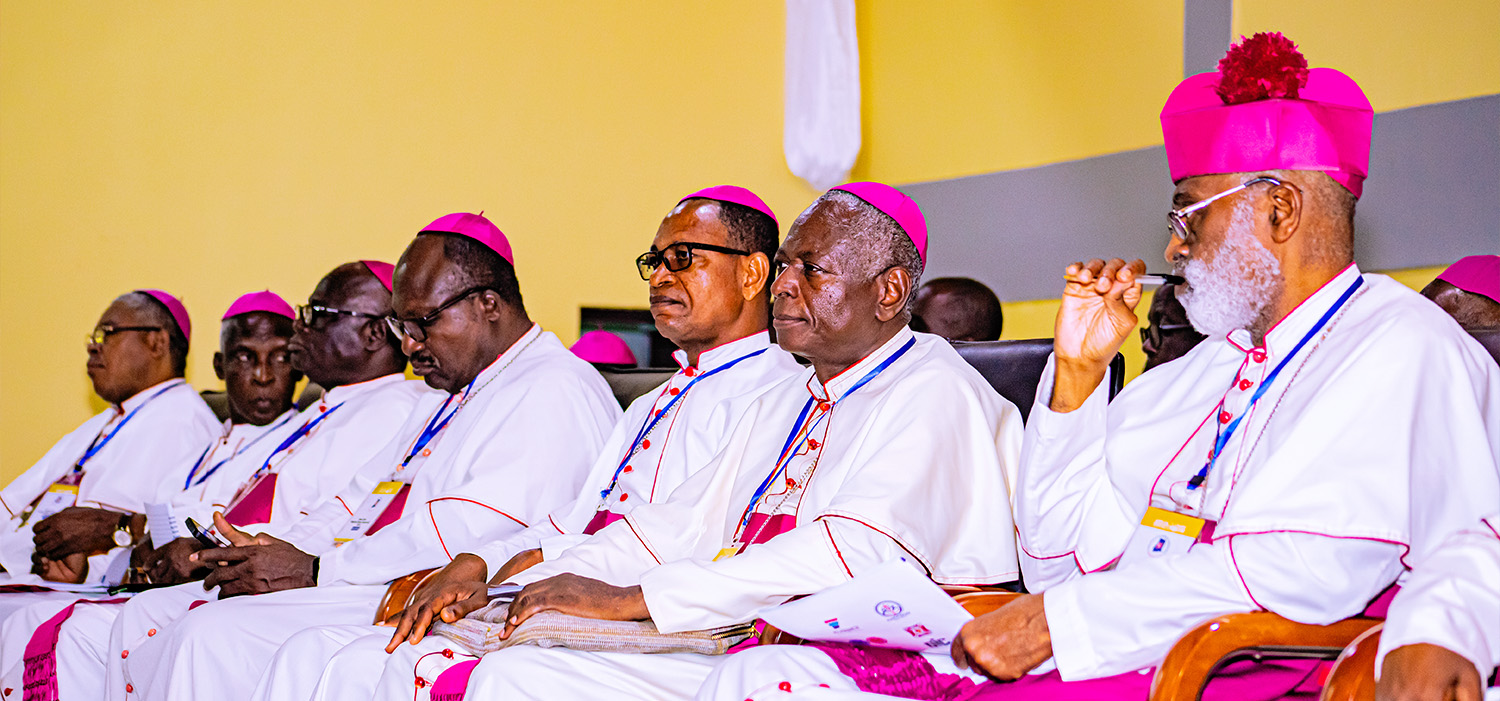
Catholic Bishops Conference (CBC) had expressed worry over recent commentaries by President Mahama and Minister for Government Communications whose comments on the LBTQ suggested that it is not a priority to Ghanaians.
According to the CBC, though economic issues may be a priority to government,
no question that touches the structure of human identity, family life, and social continuity can be trivial adding that “Nations do not live by bread alone. They are sustained also by the invisible architecture of values”.
This was contained in a statement issued on Friday and signed by
MOST REV. MATTHEW KWASI GYAMFI BISHOP OF SUNYANI AND PRESIDENT,
GHANA CATHOLIC BISHOPS’ CONFERENCE.
Below is the Press statement
GHANA CATHOLIC BISHOPS’ CONFERENCE
PASTORAL AND PUBLIC STATEMENT ON THE NATIONAL SIGNIFICANCE OF
THE FAMILY VALUES DEBATE AND THE CALL FOR COHERENT PUBLIC DISCOURSE
Introduction
Grace and peace in our Lord Jesus Christ.
We, the members of the Ghana Catholic Bishops’ Conference, write as shepherds of the faithful and as citizens deeply invested in the spiritual, moral, social, and democratic flourishing of our nation. Our voice is pastoral, guided by scriptures, conscience, reason, and a long tradition of reflection on human dignity and the common good.
Recent public remarks by His Excellency John Dramani Mahama, and the Minister of Government Communications, Hon. Felix Kwakye Ofosu, have occasioned this reflection. We respond with respect for their offices and with a sincere desire to deepen, rather than diminish, the quality of national conversation.
- On the Characterisation of the Debate
We note reports that the President, speaking at the World Affairs Council, described LGBTQ+ matters as “not the most important issue we face as a nation.” The Minister, in subsequent commentary, suggested that such matters are “not a major priority for Ghanaians,” and further characterised the debate as a “waste of time.”
Even if intended to prioritise urgent socio-economic concerns, such descriptions risk conveying that certain moral questions may be set aside as inconsequential. Yet no question that touches the structure of human identity, family life, and social continuity can be trivial. Nations do not live by bread alone. They are sustained also by the invisible architecture of values. - The False Dichotomy Between Economics and Ethics
We readily acknowledge the weight of Ghana’s present challenges. Inflationary pressures strain households. Youth unemployment remains stubborn. Gaps in healthcare and education demand urgent reform. On these matters, the Church has spoken consistently and will continue to advocate policies that promote equity, opportunity, and human development.
However, it is analytically unsound to frame a choice between economic progress and moral coherence. The two are not rivals but companions. Empirical social research across contexts shows that stable family structures correlate with improved educational outcomes, reduced crime rates, and greater economic mobility. The family, in quiet ways, is a nation’s most efficient social welfare system.
To weaken the moral ecology of the family is to erode the very conditions that make sustainable development possible. - Why the Debate Endures in the Ghanaian Consciousness
For a significant majority of Ghanaians, questions surrounding marriage, sexuality, and the family are not peripheral curiosities. They are matters of deep moral, religious, and cultural significance. The persistence of public engagement across churches, mosques, traditional councils, and civic forums attests to this.
By “family values,” we refer to the understanding of marriage as a lifelong union between one man and one woman, ordered toward mutual good and the procreation and formation of children. This vision, shared across many religious and cultural traditions in Ghana, recognises the family as the first school of virtue and the seedbed of civic responsibility.
When the family flourishes, society finds coherence. When it fractures, social costs multiply, often silently, often generationally. - Two Principles That Must Not Be Divided
The Catholic Church reaffirms two principles which must always be held together, like the two lungs by which a just society breathes.
First, the inviolable dignity of every human person. No individual, regardless of sexual orientation or identity, may be subjected to violence, hatred, or unjust discrimination. Such acts are moral failures and social wounds. We condemn them without reservation.
Second, the legitimate responsibility of society to uphold and protect the institution of the family, founded upon the union of a man and a woman. This is not an act of exclusion but a recognition of a unique anthropological and social reality.
To affirm dignity does not require the redefinition of marriage. To defend marriage does not require hostility. Where either principle is isolated, distortion follows. - The Human Sexual Rights and Family Values Bill
We have followed attentively the legislative process concerning the Human Sexual Rights and Family Values Bill. We respectfully recall the President’s earlier public assurance that he would assent to the Bill should it be duly passed in accordance with constitutional procedures.
Democratic integrity rests, in part, on the fidelity of leaders to their publicly stated commitments. Should Parliament complete its deliberations and pass the Bill, we urge the President to honour this assurance.
At the same time, we recognise that aspects of the Bill have generated legitimate concern. These concerns deserve careful legislative scrutiny and, where necessary, refinement. The law, in its final form, must reflect both the moral convictions of the Ghanaian people and the constitutional commitment to human dignity and fundamental rights. - A Call for Serious and Respectful National Dialogue
No enduring moral question can be dismissed without cost. To describe such a debate as a “waste of time” risks alienating citizens for whom these issues are existentially meaningful.
We therefore call upon all stakeholders, the executive, the legislature, religious leaders, traditional authorities, and civil society, to engage in dialogue marked by intellectual seriousness, mutual respect, and moral clarity. The tone of our discourse matters as much as its content. Words can either build a republic of trust or fracture it into suspicion.
The Church remains committed to participating in this dialogue, not as one who imposes, but as one who proposes, confident that truth, when patiently articulated, has a quiet persuasive power.
Conclusion
Ghana stands at a delicate intersection where economic aspiration meets moral self-definition. The choices we make now will echo beyond policy cycles into the moral memory of generations yet unborn.
We pray that our nation may be guided by wisdom, anchored in justice, and animated by charity. May every person’s dignity be safeguarded. May the family, that small but sovereign sanctuary of life and love, be protected and strengthened.
We entrust Ghana to the intercession of the Blessed Virgin Mary and Saint Joseph, guardians of the Holy Family and patrons of faithful stewardship.
May God bless our homeland Ghana and make her great and strong.
MOST REV. MATTHEW KWASI GYAMFI BISHOP OF SUNYANI AND PRESIDENT,
GHANA CATHOLIC BISHOPS’ CONFERENCE
FRIDAY, APRIL 10, 2026