

If Ghana has conspicuously failed to turn the existing numerous natural resources into prosperity for the nation, why should there be a rush to exploit another resource?
Ghana is once again confronted with a fundamental question about its natural resources: should we pursue every available opportunity to extract mineral wealth, or should we first determine whether doing so will genuinely improve the lives of Ghanaians? Apart from gold which has been exploited in Ghana for over a century, the country has been also exploiting bauxite, diamonds, salt, petroleum, and currently some serious attempts are being made towards lithium.
This question has become particularly important as concerns grow over illegal mining, the destruction of river bodies and forests, and ridiculously, the reported interest in exploring offshore gold resources along Ghana’s western coastline targeting about 10,000km2, overlapping the inshore exclusive zone (IEZ) reserved for artisanal fishers and extending 30km into the exclusive economic zone (EEZ)
For years, Ghanaians have watched rivers become polluted, farmlands deteriorate and communities struggle with the consequences of illegal mining, popularly known as galamsey. The warning signs are difficult to ignore, but touted efforts by successive governments have woefully failed to stop the menace. When rivers that sustain communities and support agriculture and fisheries are reduced to heavily polluted waterways, the country must confront the true cost of its pursuit of mineral wealth.
Yet, even as we struggle to address the environmental, economic and social consequences of mining on land and in river bodies, the recent quest by a private entity, Gold Coast Resource Corporation (GRC) Ghana Limited to explore/exploit gold resources beneath our seas introduces another important question: Does Ghana have adequate capacity to manage another extractive industry in a manner that protects the marine environment as well as fisheries livelihoods, and delivers lasting benefits to Ghanaians, or is it another reckless adventure to go after gold?
This is not an argument against big investment or scientific exploration. It is an argument for caution, transparency and a development model that puts the welfare of the Ghanaian people first.
THE LESSON FROM OUR EXISTING NATURAL WEALTH
Ghana is richly endowed with gold, oil, cocoa, timber, fisheries and other natural resources. These resources should provide a foundation for economic transformation, value addition, employment creation, infrastructure development and improved living standards.
However, the mere availability of natural resources does not automatically translate into widespread prosperity.
Many communities located close to mining operations are the worst affected and continue to face difficult living conditions. Environmental degradation, competing land uses, human rights abuses, pressure on water resources and concerns about how mining revenues are managed remain important issues in Ghana’s development debate.
The central challenge, therefore, is not simply whether Ghana possesses valuable resources. It is whether the country has the institutions, accountability mechanisms and long-term development strategy required to convert those resources into sustainable public benefits.
If we have struggled to manage the environmental and social consequences of mining on land, it is reasonable to ask what safeguards would be required to prevent similar problems offshore. Already, the country’s maritime space is challenged by crimes such as armed robbery at sea, drug trafficking, illegal fishing and pollution.
We must not allow the excitement of discovering another source of gold to distract us from the more important task of ensuring that our existing natural wealth works for our people.
OFFSHORE GOLD: AN OPPORTUNITY OR ANOTHER NATIONAL RISK?
Reports that Gold Coast Resource Corp. has been granted offshore reconnaissance licences covering approximately 10,000 square kilometers along Ghana’s western continental shelf have brought this issue into sharper focus. This is against the backdrop of the designated zone providing livelihood to thousands of artisanal fishers in Central and Western regions of Ghana, and serving as spawning grounds for important commercial fish species which has necessitated the establishment of Ghana’s first marine protected Area (MPA).
The reported suspension of reconnaissance activities on 14 October 2026 by government, pending stakeholder consultations, provides an opportunity for Ghana to pause, ask difficult questions and establish the facts before proceeding further.
It is important to distinguish reconnaissance and exploration from commercial mining. A licence to investigate mineral potential does not, by itself, establish that commercial extraction has been approved or that it will eventually take place.
Nevertheless, the early stages of a potentially significant extractive venture are precisely when the country should establish clear conditions, assess risks and determine whether the anticipated benefits justify the costs.
The question is not simply whether gold exists beneath Ghana’s exclusive economic zone (EEZ). It is whether extracting it would be economically worthwhile, environmentally responsible and socially beneficial.
What would be the likely contribution to government revenue? How many sustainable jobs would be created for Ghanaians? What proportion of the economic benefits would remain in the country? What risks could arise for marine ecosystems, fishing grounds and coastal communities? Who would bear the costs if the project caused serious environmental damage?
These are not questions to be postponed until commercial operations are imminent. They must be addressed before Ghana makes commitments that could be difficult or costly to reverse.
OUR SEAS ARE NOT EMPTY SPACES
Ghana’s marine environment is an economic resource in its own right.
For thousands of fishers, fish processors, traders, transport operators and other coastal workers, the sea is a source of income and the foundation of family livelihoods culture and traditions. Marine ecosystems also support biodiversity, food security and the long-term productivity of fisheries.
Any offshore gold exploration or future extraction must therefore be assessed against the possibility of disrupting these existing economic activities.
The potential risks will depend on the actual technologies used, the location and scale of operations, and the environmental conditions. They should not be exaggerated, but neither should they be dismissed without credible scientific evidence.
Ghana needs independent assessments of possible impacts on marine habitats, water quality, fishing grounds, fish stocks and coastal livelihoods. These assessments must consider cumulative impacts, including the combined effects of existing pressures and any new offshore operations.
Fishers and coastal communities must be involved in the decision-making process, not merely informed after major decisions have already been made. For a country where fish is an important source of animal protein and the fisheries sector supports millions of livelihoods directly and indirectly, the protection of marine resources is a development priority.
We must not sacrifice a productive and renewable source of food and employment for mineral revenue without demonstrating that the overall national benefits justify the risks.
WHAT CAN GHANA LEARN FROM OTHER COUNTRIES?
International experience shows that natural resources can support development, but the results depend heavily on how governments manage the revenues, protect the environment and invest in their people.
Botswana is often cited for its management of diamond revenues and the contribution of the diamond industry to national development. Yet the country’s continuing challenges with economic diversification and employment also demonstrate that resource wealth alone cannot resolve every developmental problem.
Nigeria, despite its substantial oil resources, illustrates how dependence on extractive revenues can coexist with inequality, environmental challenges and difficulties in translating national wealth into broad-based prosperity.
Norway offers another important lesson. Its management of petroleum wealth through a sovereign wealth fund reflects a deliberate effort to preserve part of the benefits of non-renewable resources for future generations.
These examples are not identical to Ghana’s circumstances, and none provides a perfect model to copy. Their broader lesson, however, is clear: discovering and extracting resources is only one part of the development equation. Institutions, transparency, prudent revenue management, environmental protection and investment in human development determine much of the ultimate outcome.
Ghana must therefore look beyond the anticipated value of offshore gold prospecting and consider how much it is likely to impact or displace existing blue economy sectors such as fisheries which already provides substantial fisheries livelihoods and food security to many millions across the country. Galamsey has already decimated agriculture and fisheries in the affected areas through destruction of farmlands and pollution of lands and water bodies. We may also have to give consideration to how revenue accruing from the offshore gold prospecting would be managed, what lasting assets it would finance and how the benefits would reach ordinary citizens, especially those whose livelihoods would be directly affected. Would the proceeds support quality education, accessible healthcare, productive infrastructure, fisheries development and employment? Would they strengthen the economy’s capacity to create opportunities beyond mining? Would future generations inherit a stronger economy and a healthier environment? If these questions cannot be answered convincingly, the economic case for extraction remains incomplete.
THE OPPORTUNITY COST: WHAT MIGHT GHANA LOSE?
Public discussions about natural resources often focus on what a country stands to gain. Responsible policymaking also requires an honest assessment of what it could lose.
This is the principle of opportunity cost.
If offshore operations threaten fishing activities, marine ecosystems or coastal livelihoods, those potential losses must be included in the economic assessment. The analysis must also consider the costs of monitoring and enforcement, environmental restoration, compensation where legally warranted, and the consequences of any accident or long-term damage.
The assessment should compare the expected benefits of extraction with the full economic, environmental and social costs. It should also consider alternative uses of public resources and the possibility that protecting marine ecosystems may generate greater long-term benefits.
The relevant question is not whether offshore gold can generate revenue. It is whether the net benefits to Ghana would exceed the full costs and risks, including those that may be difficult to reverse. Gold is finite. Once extracted, it cannot be replaced. A damaged ecosystem or depleted fishery, however, may undermine livelihoods and food security for many years.
A country should not measure the success of its natural-resource policy by how much wealth it extracts, but by how much lasting value that wealth creates for its people.
TRANSPARENCY MUST COME BEFORE EXTRACTION
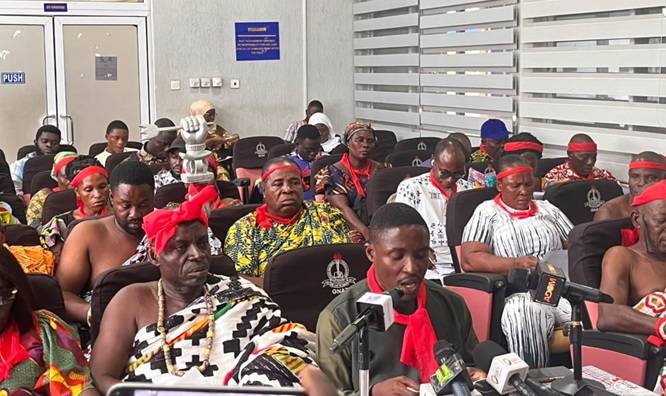
Ghana should use the current pause in offshore reconnaissance activities as an opportunity to establish a transparent and credible decision-making process. The apparent lack of transparency caused concerned citizens, including fishers, scientists and CSOs to protest the proposed offshore gold reconnaisance activities, and the Fisheries Commission to draw attention to the lack of consideration of the project’s impact on the marine environment, which cumulatively led to the formal suspension of the offshore exploratory licences by the Minerals Commission.
First, the relevant authorities should make the applicable licences, their scope, conditions and legal implications accessible to the public, subject to legitimate legal and confidentiality requirements. Citizens need to understand what has been authorised, what remains outstanding and what decisions may arise at later stages.
Second, independent experts should undertake the necessary geological, economic, environmental and social assessments. These should examine the proposed methods, technical feasibility, commercial viability, environmental risks and likely national benefits.
Third, the Fisheries Commission and other relevant institutions should assess the implications for fisheries, marine ecosystems, food security and coastal livelihoods. The concerns of fishing communities must be properly documented and considered.
Fourth, stakeholder consultations should be meaningful and inclusive. They should involve affected communities, traditional authorities, fishers’ organisations, environmental groups, researchers, civil society, relevant government agencies and other interested parties. Consultation must provide a genuine opportunity to influence decisions, rather than serve as a formality after the direction has already been determined.
Fifth, Ghana must establish whether it has the regulatory capacity, technical expertise, monitoring systems and enforcement mechanisms required to oversee such an operation effectively. Where significant gaps exist, they should be addressed before any further authorisation is considered.
Finally, the government should communicate its decision and the evidence supporting it. The public deserves to know why the country intends to proceed, impose additional conditions or decline the opportunity.
These measures are not intended to frustrate investment. They are necessary to protect legitimate investors, public interests and the country’s long-term economic prospects.
GHANA MUST BE PREPARED TO SAY NO
One of the most important tests of resource governance is whether a country can decline an investment when its costs and risks outweigh its benefits.
The existence of a mineral deposit does not create an obligation to extract it. Nor should the prospect of investment automatically override environmental protection, food security and the welfare of local communities.
Ghana should maintain the suspension of offshore reconnaissance activities while the necessary independent assessments and stakeholder consultations are undertaken. Any decision to resume activities should be informed by the evidence, applicable law and the conditions required to protect the public interest.
Commercial extraction should not proceed unless the government can demonstrate that the anticipated national benefits justify the full economic, environmental and social costs; that the risks can be managed to an acceptable level; and that effective regulatory and accountability systems will be in place.
If these conditions cannot be met, Ghana should be prepared to withhold further approvals or take other lawful measures, as appropriate.
This precautionary approach does not amount to hostility towards business or investment. Rather, it recognises that responsible investment must serve a legitimate national development purpose.
Investors may reasonably seek returns on their investments. The government’s responsibility, however, is to ensure that the pursuit of those returns does not impose unacceptable costs on the public or undermine the interests of future generations.
THE REAL MEASURE OF NATIONAL WEALTH
Ultimately, the offshore gold debate is part of a much larger question about Ghana’s development priorities. For decades, the country has relied on its natural resources as an important source of export earnings and government revenue. Yet the challenge of ensuring that economic growth translates into better living conditions for all remains central to national development.
Ordinary Ghanaians should not have to choose between mineral wealth and clean rivers, between investment and sustainable livelihoods, or between government revenue and a healthy marine environment. The purpose of resource exploitation should be to improve people’s lives, expand economic opportunities, ensure sustainability of natural ecosystems and strengthen the foundations of future prosperity.
If the extraction of gold creates substantial private returns but leaves Ghana with environmental damage, weakened livelihoods and limited public benefits, then the country would have to question whether the arrangement truly serves its interests.
Conversely, if a proposal can demonstrate strong net national benefits, credible environmental safeguards, transparent revenue arrangements and effective public oversight, it may deserve serious consideration. The decision must be based on evidence, not excitement; public interest, not pressure; and long-term national value, not the mere existence of a commercially attractive resource.
CONCLUSION: GOLD AT WHAT COST?
It is right for Ghana to explore opportunities that can support economic transformation, but responsible development requires a clear distinction between resources that can be extracted and resources that need to be extracted. The unwarranted pollution of rivers and the destruction associated with illegal mining should serve as a warning against allowing the pursuit of mineral wealth to outrun the country’s capacity to manage the consequences thereof.
The prospect of offshore gold offers Ghana an opportunity to demonstrate that it has learned from past experiences. The country can either repeat the familiar pattern of prioritising extraction before fully addressing the costs, or establish a higher standard of transparency, accountability and environmental responsibility. The choice should not be driven by the question of how much gold lies beneath our seas. It should be driven by whether exploiting that gold would leave the country better off.
Before Ghana takes another step towards offshore gold extraction, we must answer a fundamental question: Will this venture create lasting prosperity for Ghanaians, or will it simply add another resource to the list of national wealth whose benefits remain unevenly distributed?
If we cannot demonstrate that the benefits will outweigh the full costs and risks, then restraint is not a failure of development. It is an expression of responsible leadership. Ghana must protect its rivers, forests, fisheries and marine ecosystems while ensuring that its natural wealth serves the people. Our responsibility is not to extract everything that nature has placed within our reach. It is to make wise choices about what we extract, how we manage it and what we leave behind.
The true measure of Ghana’s mineral wealth will not be the gold we remove from the earth or the seabed. It will be the quality of life we build for our people.
By Hayford Agbekpornu
Concerned Citizen